Minutes, Agendas, and the Truth They Tell: Auditing the Documents That Define Your Organization
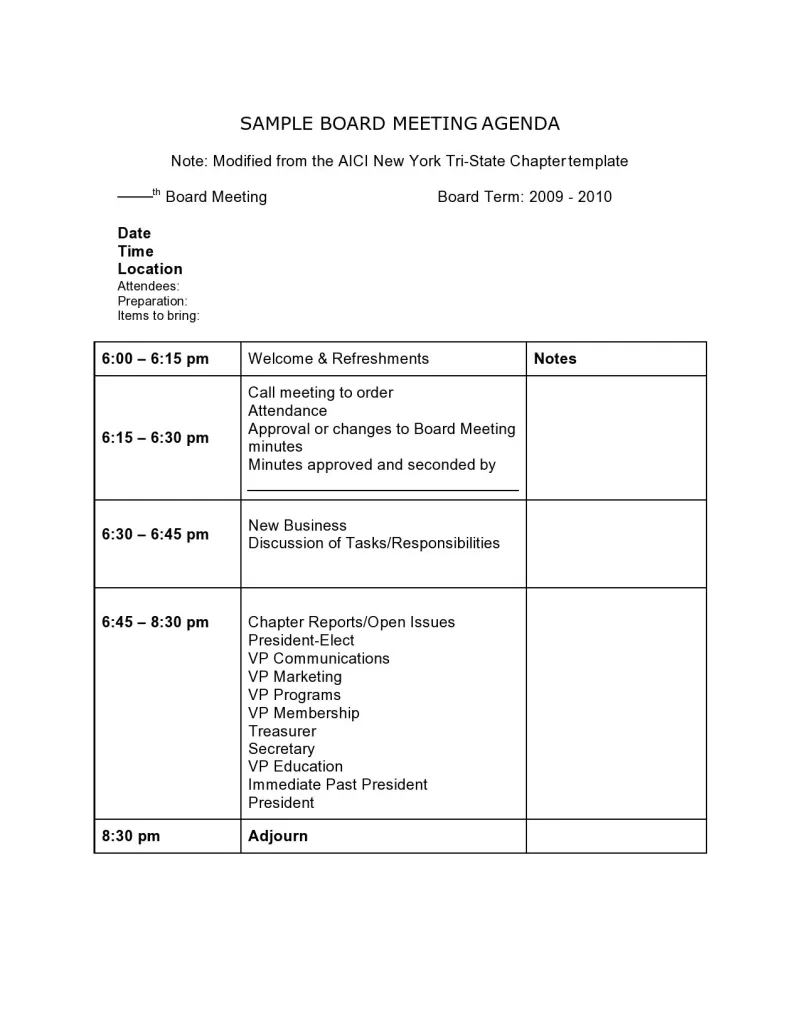
Photo: board meeting agenda papers documents on table nonprofit governance, via templatelab.com
Every community organization eventually writes down what it believes. Mission statements get drafted, values get laminated onto lobby walls, and strategic plans receive their formal adoption votes. Yet the document that most honestly describes how an organization actually operates is rarely any of these. It is the meeting packet — the humble stack of agendas, minutes, and attachments that circulates before every gathering of the board or membership.
For stakeholders and partners evaluating an organization, these routine papers function as a kind of X-ray. They show who speaks, who is recorded, what gets decided, and — just as revealingly — what gets left out. At ICC2, we encourage members to treat their document habits not as administrative trivia but as a governance instrument worth deliberate design.
The Agenda as a Statement of Priorities
Consider what an agenda communicates before a single word is spoken. The order of items signals importance: whatever appears first receives the freshest attention, while items buried after the break are often rushed or deferred indefinitely. A recurring agenda that allocates forty minutes to facility maintenance and ten to program outcomes is telling the room — and everyone who later reads the minutes — exactly where the organization's heart lies.
Agenda structure also determines who participates. If public comment appears only when time permits, or if action items are framed so that discussion is already foreclosed, the agenda has quietly made a governance decision on the board's behalf. Organizations committed to advancing community cooperation tend to build agendas that invite contribution rather than merely announce conclusions.
Minutes That Remember — and Minutes That Forget
Minutes occupy a peculiar position in American nonprofit life. They are the official memory of the organization, admissible evidence of its deliberations, and often the only record a future board member, funder, or regulator will ever consult. Yet minute-taking practices vary wildly, and the variations are rarely neutral.
Some organizations produce minutes that read like a transcript of consensus: motions carried, votes tallied, nothing else. Others record the substance of debate, including the concerns raised and the directors who raised them. The difference matters. When a board votes unanimously on a decision that two members privately doubted, minutes that scrub away that doubt create a false historical record — and deny future leaders the context they will need.
The most defensible practice sits between the extremes. Record motions precisely, note the vote count, and summarize significant dissent in neutral language: "Director Alvarez opposed the motion, citing unresolved questions about vendor selection." This is not disloyalty. It is the institutional memory working as intended, protecting both the organization and the individuals who served it.
How Dissent Is Handled Reveals Everything
No healthy board agrees on everything. The question is not whether disagreement occurs but whether the organization's paperwork acknowledges it. An organization whose minutes show years of unanimous votes on complex decisions should prompt a closer look — not because unanimity is impossible, but because it is statistically improbable over time.
Partners conducting diligence increasingly understand this. A coalition reviewing a prospective member organization, or a funder assessing a grantee's governance, can learn more from three years of minutes than from any annual report. Documents that show genuine deliberation — questions asked, alternatives weighed, concerns logged — signal a board that functions. Documents that show only outcomes signal a board that may merely perform.
A Practical Document Culture Audit
Leaders who suspect their paperwork may be understating their values can run a straightforward audit in a single afternoon:
- Pull the last twelve meeting packets. Read only the agendas, in sequence. List what received the most time and what was repeatedly tabled.
- Trace the action items. For each decision recorded, confirm that a responsible party and a follow-up date appear somewhere in the record.
- Count the silences. Identify meetings with no recorded questions, no abstentions, and no minority positions. Ask whether that reflects genuine alignment or discomfort with the record.
- Check accessibility. Are minutes distributed promptly, in plain language, to all members entitled to them? Delayed or jargon-heavy minutes function as a soft form of exclusion.
- Test the retention path. Could a new board member, given only the archive, reconstruct why major decisions were made? If not, the institutional memory has a gap that will eventually cost someone.
Organizations that find gaps should treat them as opportunities rather than failures. Revising a minutes template, restructuring an agenda to put member-facing business first, or adopting a standing format for recording dissent are all changes that can be made at the next regularly scheduled meeting.
Paperwork as an Expression of Mission
It is tempting to regard governance documents as overhead — necessary, unglamorous, and best handled quickly. But for organizations whose mission depends on community trust, the paperwork is the mission in its most durable form. A community group that preaches transparency while keeping minutes no one can find, or inclusion while running agendas that allow no room for members to speak, will eventually be judged by the contradiction.
The reverse is also true. Organizations whose routine documents reflect care, candor, and structure earn a quiet credibility that no marketing effort can purchase. Partners notice. Funders notice. Most importantly, members notice — because the meeting packet is the one document they all hold in their hands.
The culture of an organization is not what it declares. It is what it writes down, distributes, and preserves. Leaders willing to audit those records honestly will find either confirmation that their values are holding, or an early and fixable warning that they are not.